Understanding order_item_cons_data_2: Complete Guide to Order Item Confirmation Data
If you’re working with order management systems, you’ve likely encountered the term order_item_cons_data_2. But what exactly is it, and why does it matter?
This term refers to a database structure used to track order item confirmations, serial numbers, and shipment data. It is commonly found in enterprise e-commerce platforms like HCL Commerce and IBM WebSphere Commerce.
This guide covers the table structure, relationships, use cases, and best practices for managing order item confirmation data. We’ll explore everything from column descriptions to SQL queries. Let’s dive in.
Also on Axeetech: Gachikoi Meaning | LookMovieto.2 |
What is order_item_cons_data_2?
order_item_cons_data_2 relates to the ORDITEMCONF table in databases. This table checks order item shipment confirmations and captures order serial numbers.
The ORDITEMCONF table links order items with their shipment and receipt status. It confirms when items ship and tracks serial numbers for individual products. Platforms using this structure include HCL Commerce, IBM WebSphere Commerce, SAP, and Shopify through CData connectors.
This table plays a vital role in order management and fulfillment. It helps businesses track exactly what was shipped, when it was shipped, and which serial numbers went to which customers.
Related tables include ORDERITEMS, OICOMPLIST, and MANIFEST.
Complete Table Structure and Column Descriptions
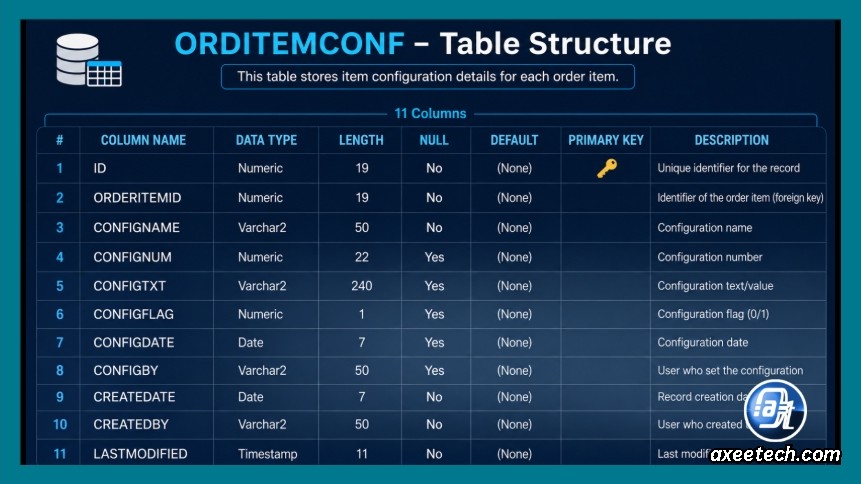
The ORDITEMCONF table has 11 columns. Here is the complete breakdown.
| Column Name | Data Type | Nullable | Description |
|---|---|---|---|
| ORDITEMCONF_ID | BIGINT | NOT NULL | Generated order item confirmation identifier (Primary Key) |
| ORDERITEMS_ID | BIGINT | NOT NULL | Identifier of the order item associated with this serial number |
| OICOMPLIST_ID | BIGINT | Yes | Component identifier of a configured order item |
| SERIALNUMBER | VARCHAR(128) | Yes | String representation of the serial number |
| MANIFEST_ID | BIGINT | Yes | Shipping manifest identifier for the shipment |
| ORDRELEASENUM | INTEGER | NOT NULL | Identifier of the release |
| QUANTITY | DOUBLE | NOT NULL | Quantity shipped within this package |
| CONFIRMTYPE | SMALLINT | NOT NULL | Confirmation type indicator |
| CREATION_TIMESTAMP | TIMESTAMP | NOT NULL | Time when the confirmation was recorded |
| LASTUPDATE | TIMESTAMP | NOT NULL | Time of the last update |
| OPTCOUNTER | SMALLINT | NOT NULL DEFAULT 0 | Optimistic concurrency control counter |
Understanding CONFIRMTYPE Values
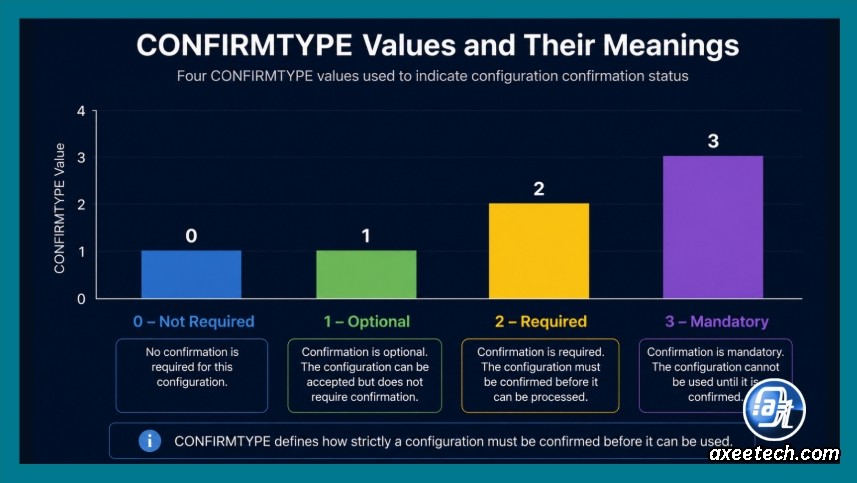
The CONFIRMTYPE column uses four specific values.
- 0 – Order item shipment confirmation
- 1 – Serial number shipment confirmation
- 2 – Order item receipt confirmation
- 3 – Serial number receipt confirmation
These values distinguish between shipment and receipt events, and between item-level and serial-level tracking.
Indexes and Performance Optimization
The ORDITEMCONF table includes several indexes to improve query performance.
| Index Name | Columns | Type |
|---|---|---|
| SYSTEM-GENERATED | ORDITEMCONF_ID | Primary Key |
| I0000974 | ORDERITEMS_ID + OICOMPLIST_ID | Non-Unique |
| I0000975 | SERIALNUMBER | Non-Unique |
| I0001268 | OICOMPLIST_ID | Non-Unique |
| I0001269 | MANIFEST_ID | Non-Unique |
Query Optimization Tips
Index the SERIALNUMBER column for serial number lookups. This speeds up searches when tracking specific products.
Use the composite index on ORDERITEMS_ID and OICOMPLIST_ID for queries joining multiple order items. This reduces table scans.
Consider partitioning large tables by CREATION_TIMESTAMP for better performance with date-range queries.
Optimistic Concurrency Control (OPTCOUNTER)
The OPTCOUNTER column prevents lost updates. Every update increments this counter. When updating a row, check that the counter hasn’t changed since you read the data. If it has, someone else modified the record. This handles concurrent access in high-volume systems.
Foreign Key Relationships and Parent Tables
The ORDITEMCONF table has three foreign key relationships with parent tables.
text
                    ┌─────────────────┐
                    │   ORDERITEMS    │
                    │  (Parent Table) │
                    └────────┬────────┘
                             │ ORDERITEMS_ID
                             ▼
                    ┌─────────────────┐
                    │  ORDITEMCONF    │
                    │  (Child Table)  │
                    └────────┬────────┘
                             │
        ┌────────────────────┼────────────────────┐
        │                    │                    │
        ▼                    ▼                    ▼
┌───────────────┐   ┌───────────────┐   ┌───────────────┐
│  OICOMPLIST   │   │   MANIFEST    │   │ (No Cascade)  │
│ (Parent Table)│   │ (Parent Table)│   │               │
└───────────────┘   └───────────────┘   └───────────────┘

Parent Table Details
- ORDERITEMS: Each row represents an order item. This is the main parent table. The ORDITEMCONF record cannot exist without a valid ORDERITEMS_ID.
- OICOMPLIST: Stores component information for configured order items. Used when tracking serial numbers for product components.
- MANIFEST: Contains shipping manifest data. Links confirmations to specific shipments.
All three foreign key constraints use CASCADE delete. Deleting a parent record automatically deletes related ORDITEMCONF records.
Common Use Cases for order_item_cons_data_2

Shipment Confirmation Tracking
The table records when order items ship. The CONFIRMTYPE value 0 indicates a shipment confirmation. This creates an audit trail of what shipped and when.
Serial Number Management
CONFIRMTYPE 1 tracks serial number shipment confirmations. The SERIALNUMBER column stores individual product serial numbers. This helps with warranty tracking and recalls.
Order Fulfillment Auditing
CREATION_TIMESTAMP and LASTUPDATE record when confirmations happened. This builds a complete audit trail for compliance and troubleshooting.
Inventory Reconciliation
The QUANTITY column records shipped quantities. Compare this with inventory systems to ensure accuracy and identify discrepancies.
Return Processing
When customers return items, CONFIRMTYPE 2 and 3 handle receipt confirmations. This completes the fulfillment loop.
How to Query order_item_cons_data_2 (SQL Examples)
Basic SELECT Query
SELECT
    ORDITEMCONF_ID,
    ORDERITEMS_ID,
    SERIALNUMBER,
    QUANTITY,
    CONFIRMTYPE,
    CREATION_TIMESTAMP
FROM ORDITEMCONF
WHERE CREATION_TIMESTAMP >= '2026-01-01'
ORDER BY CREATION_TIMESTAMP DESC;
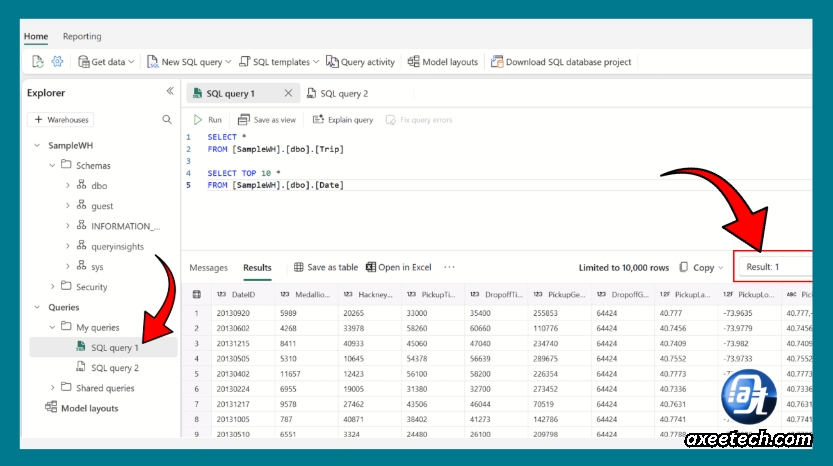
This retrieves recent confirmations. Use it for audit reports or daily reconciliation.
JOIN with ORDERITEMS Table
SELECT
    oi.ORDERITEMS_ID,
    oi.PARTNUM,
    oi.QUANTITY AS ORDERED_QTY,
    oc.QUANTITY AS SHIPPED_QTY,
    oc.SERIALNUMBER,
    oc.CONFIRMTYPE,
    oc.CREATION_TIMESTAMP
FROM ORDERITEMS oi
INNER JOIN ORDITEMCONF oc
    ON oi.ORDERITEMS_ID = oc.ORDERITEMS_ID
WHERE oc.CONFIRMTYPE IN (0, 1)
ORDER BY oc.CREATION_TIMESTAMP DESC;
This joins order items with their confirmations. It shows what was ordered versus what shipped.
Filtering by CONFIRMTYPE
SELECT
    SERIALNUMBER,
    QUANTITY,
    CREATION_TIMESTAMP
FROM ORDITEMCONF
WHERE CONFIRMTYPE = 1  -- Serial number shipment confirmations
AND SERIALNUMBER IS NOT NULL;
This finds all serial number confirmations. Useful for product tracking and warranty registration.
Date Range Queries
SELECT
    DATE(CREATION_TIMESTAMP) AS CONFIRMATION_DATE,
    COUNT(*) AS TOTAL_CONFIRMATIONS,
    SUM(QUANTITY) AS TOTAL_UNITS_SHIPPED
FROM ORDITEMCONF
WHERE CREATION_TIMESTAMP BETWEEN '2026-01-01' AND '2026-03-31'
GROUP BY DATE(CREATION_TIMESTAMP)
ORDER BY CONFIRMATION_DATE DESC;
These aggregates confirmations by day. It helps with shipping volume reporting.
Aggregation for Reporting
SELECT
    CONFIRMTYPE,
    COUNT(*) AS RECORD_COUNT,
    SUM(QUANTITY) AS TOTAL_QUANTITY
FROM ORDITEMCONF
GROUP BY CONFIRMTYPE;
This shows the distribution of confirmation types. It provides insight into shipping versus receipt activity.
order_item_cons_data_2 Across Different Platforms
HCL Commerce
The ORDITEMCONF table checks order item shipment confirmation and captures serial numbers. It includes all 11 columns described above.
IBM WebSphere Commerce
The same ORDITEMCONF table exists in WebSphere Commerce. The structure is identical. WebSphere Commerce also includes FACT_ORDERITEMS for data warehousing, which stores order information across stores.
SAP
SAP uses purchase order item confirmations with technical IDs. The approach differs but serves the same purpose. SAP tracks confirmation percentages and statuses.
Shopify (CData)
CData connectors expose an OrdersItems table. Columns include ItemId, OrderId, ProductId, ItemQuantity, ItemPrice, SKU, and FulfillmentStatus. This is the Shopify equivalent.
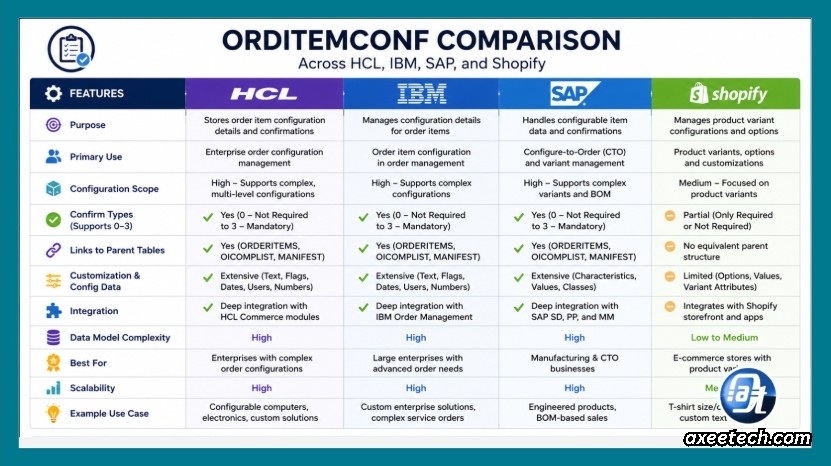
Comparison Table
| Feature | HCL Commerce | IBM WebSphere | SAP | Shopify (CData) |
|---|---|---|---|---|
| Table Name | ORDITEMCONF | ORDITEMCONF | Purchase Order Items | OrdersItems |
| Serial Number Support | Yes | Yes | Limited | No |
| Confirmation Types | 4 types | 4 types | Status-based | FulfillmentStatus |
| Manifest Tracking | Yes | Yes | No | No |
| Receipt Confirmation | Yes | Yes | Yes | No |
Best Practices for Managing Order Item Confirmation Data
Data Validation
Ensure CONFIRMTYPE values are always 0, 1, 2, or 3. Invalid values break reporting and integration. Use check constraints at the database level.
Validate the SERIALNUMBER format before insertion. Define expected patterns based on product categories.
Indexing Strategy
Create indexes based on your query patterns. The SERIALNUMBER index is essential if you frequently search by serial number.
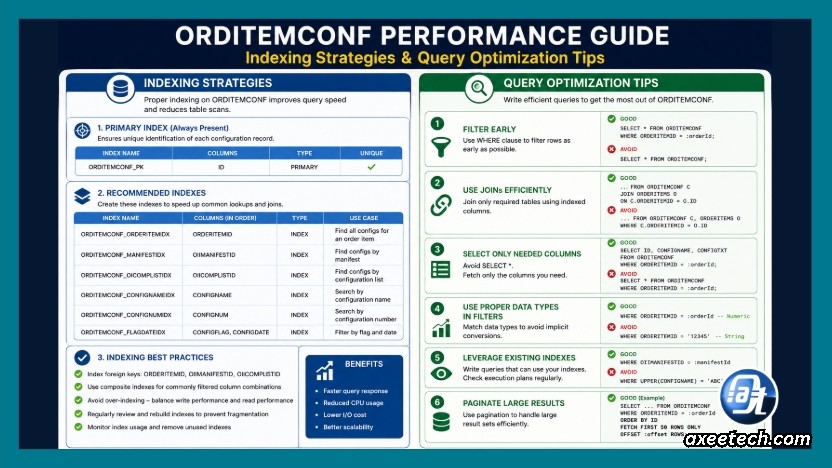
Consider covering indexes for common queries. Include frequently selected columns in the index to avoid table lookups.
Archiving Old Data
ORDERITEMCONF tables grow quickly in high-volume systems. Implement an archiving strategy for data older than 12-24 months.
Move old records to a historical table. This keeps the main table small and fast.
Audit Trails
Use LASTUPDATE and OPTCOUNTER for concurrency control. This prevents lost updates in multi-user environments.
Log changes to a separate audit table. Track who made changes and when.
Serial Number Uniqueness
Ensure serial numbers are unique where required. Add a unique constraint if your business needs it.
Handle duplicate serial numbers gracefully. Have a process to investigate and resolve conflicts.
Backup and Recovery
Include the ORDITEMCONF table in your backup strategy. It contains critical fulfillment data.
Test recovery procedures regularly. Confirm you can restore order confirmation data quickly.
Common Challenges and Troubleshooting
Duplicate Serial Numbers
Serial numbers sometimes appear multiple times. This happens with returns and reshipments.
Solution: Investigate each case. Determine if the duplicate is valid (return and reship) or an error. Add business logic to handle duplicates appropriately.
Missing Confirmation Records
Some shipments lack confirmation records. This breaks the audit trail.
Solution: Implement monitoring for missing confirmations. Create alerts when shipments are complete without confirmation records.
Performance Issues with Large Datasets
The table grows rapidly in high-volume systems. Queries become slow.
Solution: Partition by CREATION_TIMESTAMP. Archive old data. Optimize indexes based on query patterns.
Concurrency Conflicts (OPTCOUNTER)
The OPTCOUNTER prevents lost updates. But conflicts can occur in high-traffic systems.
Solution: Implement retry logic in your application. Handle OPTCOUNTER mismatches gracefully and retry the operation.
Foreign Key Constraint Violations
INSERT or UPDATE operations fail when referenced parent records don’t exist.
Solution: Verify parent records exist before inserting. Use proper transaction ordering. Handle exceptions with meaningful error messages.
Frequently Asked Questions
What is the primary key of order_item_cons_data_2?
The primary key is ORDITEMCONF_ID. It’s a BIGINT NOT NULL column that serves as the unique identifier.
How is order_item_cons_data_2 different from ORDERITEMS?
ORDERITEMS stores order item details like price, quantity, and status. ORDITEMCONF specifically tracks confirmations and serial numbers. They are separate but related tables.
What does CONFIRMTYPE 0, 1, 2, and 3 mean?
- 0: Order item shipment confirmation
- 1: Serial number shipment confirmation
- 2: Order item receipt confirmation
- 3: Serial number receipt confirmation
How do I track serial numbers using this table?
Use CONFIRMTYPE = 1 for serial number shipment confirmations. Store the serial number in the SERIALNUMBER column. Query by SERIALNUMBER to track specific products.
Can I use this table for returns processing?
Yes. Use CONFIRMTYPE = 2 for receipt confirmations. This records returned items and completes the fulfillment loop.
How do I optimize queries on this table?
Create appropriate indexes. Partition by CREATION_TIMESTAMP. Archive old data. Use covering indexes for frequent queries.
Conclusion
The order_item_cons_data_2 structure, primarily the ORDITEMCONF table, is essential for order fulfillment tracking. It records shipment confirmations, captures serial numbers, and maintains audit trails.
Key takeaways include understanding the 11 columns, using the four CONFIRMTYPE values correctly, and implementing proper indexes for performance. The table relationships with ORDERITEMS, OICOMPLIST, and MANIFEST are critical for data integrity.
Implement the best practices covered here. Validate your data, optimize your indexes, and archive old records regularly.
Start optimizing your order item confirmation data management today. Your fulfillment operations depend on accurate, reliable data.

Axee Davies is the founder of AxeeTech, publishing gaming guides, codes, and Windows how-tos since March 2013. A tech enthusiast for 13+ years — starting with smartphones and Android rooting — he now runs a site that puts out a new guide every day for Roblox players, traders, and Windows users. More about AxeeTech
More Guides You May Like
 What Is the Blue Dot Beside the Battery in Samsung Phones After the One UI 9 Update?
 ArtCraft Review: 12 Free Adobe & Microsoft Office Alternatives (Launcher + Download Guide)
 Star Citizen Retribution: What It Is and Can You Buy It
 Star Citizen Ranta Dung: Where to Find It and Price
 Star Citizen Wikelo Ships: How to Get War Special Rewards
 Star Citizen Sabre Firebird: Specs, Price and Where to Buy
 Star Citizen Executive Hangar Guide: Timer and Rewards
 Star Citizen Teach’s Ship Shop: Location and Teach’s Special