Best 5 NLP Testing Tools to Enhance Your AI Language Projects
Testing traditional code is straightforward: you expect the same input to always produce the same output. NLP testing? That’s a different story. Natural Language Processing drives everything from customer service chatbots to complex Large Language Models, but human language is messy. People use slang, make typos, and express the same idea in hundreds of different ways.
Standard test scripts break down fast when they encounter the infinite ways someone might ask, “Where’s my order?” A chatbot that responds rudely or a voice assistant that misunderstands your accent can damage your brand before you even realize there’s a problem.
This guide walks through five specialized platforms that apply AI to test AI language systems. Each one tackles the unique challenge of verifying that your NLP models correctly understand context, sentiment, and intent across countless conversation variations.
How to Select Top NLP Testing Providers
We chose these platforms based on how well they validate Natural Language Understanding accuracy, intent recognition, and full conversation flows. The information reflects conditions as of late 2026. Testing language requires different capabilities than testing structured code. Here’s what matters:
- Intent Verification: Does the tool confirm that your AI correctly identified what the user wanted?
- Conversational Flow: Can it test multi-turn dialogues where context from previous messages matters?
- Audio/Voice Support: Does it assess speech-to-text accuracy across different acoustic conditions?
- Generative Validation: Can it use LLMs to automatically create diverse test phrases?
- Integration: Does it work smoothly with platforms like Dialogflow, Amazon Lex, or your custom models?
List of the Best NLP Testing Providers
Here are the five platforms that stand out:
- Functionize
- Mabl
- HeadSpin
- ACCELQ
- Panaya
Best NLP Testing Tools
- Founded: 2014
- Headquarters: San Francisco, CA
- Key Feature: “testGPT” for generating diverse natural language test inputs
- Recognition: “Best Corporate Innovation in AI” (AIconics)
- Core Tech: NLP-driven test creation that understands plain English instructions
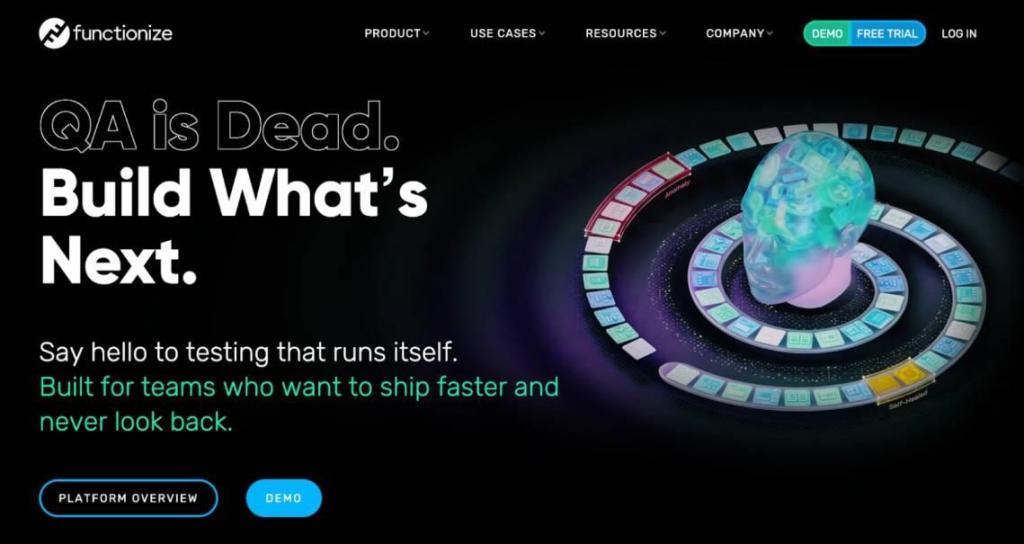
Functionize flips the script on traditional testing by using NLP to build the tests rather than just validating them. The “testGPT” engine taps into Large Language Models to automatically generate thousands of different ways people might phrase the same request. This matters because real users don’t speak like robots. They abbreviate, misspell, and mix in casual language. By creating test inputs that mirror actual human speech patterns, Functionize helps you identify where your chatbot might stumble before real customers encounter those gaps. Your QA team can feed it plain English instructions, and the system translates those into comprehensive test coverage without manual scripting.
Best For: Generating diverse, AI-driven linguistic test data to train and validate chatbots.
Standout Feature: Generative AI that creates thousands of natural language test variations automatically.
- Mabl
- Founded: 2017
- Headquarters: Boston, MA
- Key Feature: Unified Chatbot and UI testing
- Recognition: 5-time AI Breakthrough Award Winner
- Capability: Validating that chatbot responses trigger correct UI actions
Mabl connects the dots between what your chatbot says and what your application does. Think about it: if someone tells your bot “Book a flight to Chicago,” the NLP needs to understand the intent, but the software also needs to actually open the flight booking interface. Mabl tests both sides of that equation. It verifies the language processing worked correctly and confirms the resulting user interface response matches what should happen. This prevents situations where your AI appears to understand but the application fails to act on that understanding. You get full visibility into whether the conversation successfully drives the intended outcome.

Best For: Testing the functional outcome of NLP interactions within a web application.
Standout Feature: Unified verification of Chatbot text responses and resulting UI actions.
- HeadSpin
- Founded: 2015 (Acquired by PartnerOne in 2024)
- Headquarters: Sunnyvale, CA
- Key Feature: Audio/Voice Quality Testing on real devices
- Compliance: SOC 2 Type II & SOC 3
- Metric: Mean Opinion Score (MOS) for voice/speech quality
HeadSpin tackles voice AI projects where audio quality makes or breaks the experience. The platform tests how your NLP models perform when processing audio from actual smartphones, tablets, and smart speakers in varied conditions. Recording someone speaking in a quiet office versus a crowded subway station produces dramatically different audio inputs. HeadSpin captures real microphone data across these scenarios and measures speech-to-text accuracy. It calculates Mean Opinion Scores that quantify voice quality and helps you understand whether background noise, network problems, or device limitations will prevent your voice assistant from understanding commands correctly.

Best For: Voice-enabled AI/NLP projects requiring real-world audio quality validation.
Standout Feature: Testing speech recognition accuracy on real devices in diverse acoustic environments.
- ACCELQ
- Founded: 2014
- Headquarters: Dallas, TX
- Key Feature: API-level testing for NLP backends
- Recognition: Gartner Magic Quadrant Leader
- Architecture: Codeless validation of JSON responses from NLP engines
ACCELQ goes straight to the source by testing the API responses your NLP engine produces. Most commercial NLP platforms like Dialogflow or IBM Watson return structured JSON data that includes the detected intent, confidence scores, and extracted entities. ACCELQ lets you validate these backend responses without building custom scripts or touching the UI.
You can set up tests that check whether the confidence score exceeds your threshold, confirm the right intent was identified, and verify entities got extracted correctly. This matters because a low confidence score might mean your model is guessing, even if it appears to work on the surface.

Best For: Validating the structured API responses (Intents/Entities) from NLP engines.
Standout Feature: Codeless API validation to verify Intent Confidence scores and Entity extraction.
- Panaya
- Founded: 2006
- Headquarters: Hod HaSharon, Israel / Hackensack, NJ
- Key Feature: Business process validation for conversational ERPs
- Recognition: QA Vector “User Experience Testing Vendor of the Year”
- Core Tech: Ensuring NLP commands trigger correct SAP/Oracle workflows
Panaya specializes in testing conversational interfaces layered on top of enterprise resource planning systems. As companies add natural language “copilots” to platforms like SAP and Oracle, users expect to ask questions like “Show me Q3 revenue by region” and get accurate data back. Panaya validates that these natural language queries trigger the right business logic and return correct information from the ERP database. It’s not enough for the NLP to understand the question; the system needs to execute the proper transaction, pull the right report, and present accurate numbers. Panaya tests the entire chain from language understanding through business execution.

Best For: Testing conversational interfaces overlaying complex ERP systems (SAP/Oracle).
Standout Feature: Validating that NLP commands accurately execute complex business workflows.
Factors to Consider When Choosing an NLP Testing Tool
Text vs. Voice
Start by identifying whether you’re building text-based chatbots or voice assistants. Text-only projects can work well with platforms like Functionize and Mabl that focus on written language processing. Voice projects need tools like HeadSpin that account for audio quality, accents, and speech recognition accuracy. Voice adds layers of technical challenge that text systems don’t face.
Training Data Generation
Your NLP model needs exposure to thousands of phrase variations to learn properly. Someone might say “reset my password,” “I forgot my password,” “password reset help,” or dozens of other variations. Platforms like Functionize that use generative AI can automatically create these training phrases at scale. Manual creation of this data takes far too long.
Multilingual Support
If your AI serves multiple languages, confirm the testing tool handles the character sets and linguistic structures you need. Right-to-Left languages like Arabic and Hebrew, tonal languages like Mandarin, and languages with complex grammatical rules all present unique testing requirements. Verify your tool can validate accuracy across your target languages.
Context Awareness
Simple question-and-answer testing falls short for modern conversational AI. Real conversations involve multiple turns where the AI needs to remember what was said earlier. Your testing tool must validate these multi-turn dialogues. Can your chatbot handle “Book a flight to Seattle” followed by “Make it next Tuesday,” where “it” refers back to the flight? This context tracking needs testing.
Confidence Scoring
Don’t just test whether your AI gives an answer. Test whether it’s confident about that answer. Tools like ACCELQ let you validate the confidence scores your NLP engine returns. A response with 55% confidence might be technically correct, but it indicates your model is essentially guessing. You need to catch these low-confidence situations before they reach production.
Final Thoughts
NLP models work on probability, not certainty. They make educated guesses about what users mean based on patterns in their training data. Your testing strategy needs to recognize this and focus on maximizing the accuracy of those guesses across the broadest possible range of inputs. Stop limiting your tests to ideal scenarios where users type perfect sentences. Throw slang, misspellings, and confusing requests at your AI.
See how it handles edge cases. Watch how it recovers from misunderstandings. Your conversational AI represents your brand in customer interactions. If it can’t understand your customers, those customers won’t stick around to figure out why they should stay. These five tools give you the specialized capabilities to ensure your language models work reliably across the infinite variations of human communication.

Axee Davies is the founder of AxeeTech, publishing gaming guides, codes, and Windows how-tos since March 2013. A tech enthusiast for 13+ years — starting with smartphones and Android rooting — he now runs a site that puts out a new guide every day for Roblox players, traders, and Windows users. More about AxeeTech
More How to You May Like
 Top 3 Free online MBOX to PST Converters
 Windows Resource Protection Could Not Start the Repair Service
 Night Light Not Working in Windows 11: 7 Easy Fixes
 Windows 11 Update Stuck at 46%: 7 Proven Fixes
 Start Menu Not Working in Windows 11: 7 Fixes That Work
 Repair Windows 10 From USB: 7 Step-by-Step Fixes
 BitLocker Waiting for Activation: 6 Fixes That Work
 Windows RE Image Was Not Found: 6 Fixes That Work [Repair Builder]