YouWare: A Vibe Coding Workflow For Indie Game Creators
You and I both know the hard part isn’t “writing code.”
It’s keeping momentum when the idea is still fragile.
So let’s talk about YouWare as a workflow, not a miracle button, and not “a web-game-only thing” either.
What would you build if you could protect your momentum for one more week?
YouWare’s “web programming mini program” vibe is just one link in the chain, not the whole identity.
Think of it as an AI coding community and builder where you describe, generate, remix, and publish interactive projects fast.
If a tool helps you ship anything interactive faster, does it matter what bucket people put it in?

See YouWare Like A Creator, Not Like A Tool Shopper
When people search “game creator,” they often want a menu of engines.
But YouWare feels more like a creative studio that talks back.
If your goal is playable clarity, why start by picking tech instead of picking a feeling?
YouWare positions itself around building functional web apps with a no-code builder, plus an “AI Game Generator” flow for quickly creating playable, interactive experiences.
That means your prototype can behave like a game before you commit to a full engine migration.
What prototype would you finally finish if “getting to playable” took minutes instead of weekends?

And yes, people will Google “game creator online free” and “game creator without coding.”
YouWare leans into that promise with “Try it free” messaging and a low-friction start.
But the real win is not “free,” it’s “fast feedback,” so what feedback loop do you need most right now?
Start A Project The Way You Pitch A Game
Open YouWare and act like you’re pitching your game to a teammate.
Not lore.
Not backstory.
Just the loop.
If you can’t pitch the loop in four sentences, are you sure the loop is ready?
Write a prompt like this:
You are building a 2D top-down dodge game with one arena, one enemy type, and escalating speed.
The player moves with WASD, dashes with Space, and loses on one hit.
Add a score that increases over time and a restart button.
Keep the art minimal and readable.
Which part of your loop is “must-have,” and which part is you procrastinating with features?
Then ask for a first playable, not a “final game.”
Say: “Make it playable in under one minute, then we iterate.”
You’re training the collaboration style.
When was the last time you deliberately optimized for iteration speed instead of feature count?
Use Vibe Coding Rules That Keep You Honest
Rule one: constrain the surface area.
One screen.
One mechanic.
One reason to replay.
That’s it.
What would your game become if you stopped adding and started sharpening?
Rule two: force visible state.
Score, timer, health, combo, wave.
Anything you can see is easier to debug and tune.
If you can’t see it, how will you know what to change?
Rule three: ask for knobs.
Tell YouWare to expose variables like enemy speed, spawn rate, dash cooldown, i-frames.
If tuning is fun, why build a prototype that makes tuning painful?
Remix Like An Indie Who Wants To Learn Fast

YouWare is also a community surface, not just a builder.
Browsing other projects and remixing is part of the intended loop.
If you could steal one good interaction pattern today, what would it be?
Remix is underrated because it removes the blank-page tax.
You start from something that already runs, then you bend it into your taste.
What would you learn faster: reading a tutorial, or breaking a working toy on purpose?
When you remix, change one axis at a time.
Mechanic first, then feel, then visuals, then content.
If you change everything at once, how will you know what caused the improvement?
Add Real Game Loops With YouBase
Here’s the moment most “game creator without coding” tools hit a wall: persistence.
High scores.
Saves.
Accounts.
Shared worlds.
What’s your game without memory?
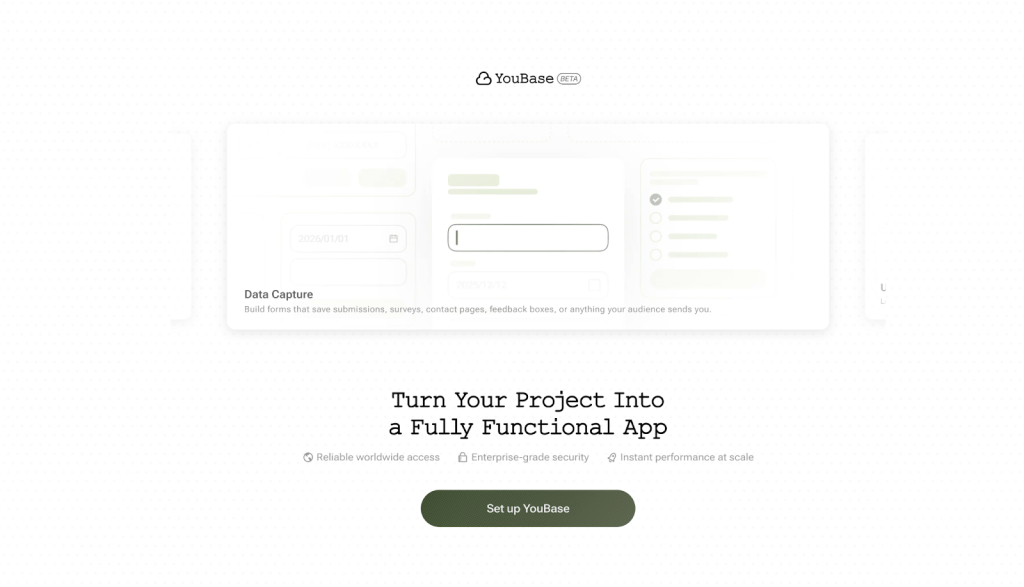
YouWare’s answer is YouBase, its cloud backend layer for storage, auth, server-side logic, and file management.
That’s the difference between “a playable demo” and “a tiny product.”
If your game remembered the player, what new loop would suddenly make sense?
Think practical indie use cases:
A global leaderboard for a 30-second arcade loop.
A daily challenge seed that resets every 24 hours.
User accounts so players can keep progress across devices.
Which one of those would make your game feel “real” with the least extra work?
You don’t need to “design a backend.”
You need to name your data: users, runs, scores, replays.
Then ask YouWare + YouBase to implement the simplest version first.
If the simplest version is boring, is the loop actually strong?
Publish Like You Mean It

Vibe coding dies in drafts.
So publish early and share the link while you still feel slightly embarrassed.
If you wait until it’s “ready,” when exactly will you collect real player reactions?
Use sharing as design pressure.
One friend.
One tiny community.
One feedback thread.
What’s the smallest audience that will still tell you the truth?
Then iterate with intent.
Fix one friction point per cycle.
Add one delight per cycle.
Delete one confusing thing per cycle.
If you can’t name the one thing you’re improving, why are you changing anything?
A 30-Minute YouWare Sprint You Can Repeat
Minute 0–5: write the loop prompt and generate a playable prototype in YouWare.
What is the one input the player repeats over and over?
Minute 5–10: ask for three tuning knobs and a basic UI showing state.
Which variable will you tweak first to change “feel” without changing “rules”?
Minute 10–15: add one juice element—screen shake, sound cue, combo pop.
What tiny feedback would make the game feel twice as alive?
Minute 15–20: add a fail state and a restart flow that’s instant.
If restarting takes effort, why would anyone chase mastery?
Minute 20–30: publish, share, and write down three observations from the first tester.
Are you collecting compliments, or are you collecting actionable friction?
Do that sprint three times and you’ll have something you can either deepen in YouWare or port into your “forever” stack.
What matters is that you now have proof, not vibes.
Common Mistakes That Kill Vibe Coding
Mistake one: you prompt for a “full game.”
You get a messy pile.
Ask for a “toy” instead, then grow it.
Are you building a game, or are you building an excuse to avoid playtesting?
Mistake two: you don’t specify constraints.
No constraints means the output drifts.
Name the camera, the controls, the win/lose, the art style.
What constraint would make your game instantly more coherent?
Mistake three: you treat backend as “later.”
Later never comes.
If your loop needs memory, add the simplest persistence with YouBase early.
What’s the smallest “memory” feature that makes players return tomorrow?
Where YouWare Fits In Your Indie Stack
Use YouWare when you want speed, clarity, and shareable prototypes.
Use it to explore mechanics, UI flows, monetizable micro-products, and community remix learning.
If your goal is learning-by-shipping, why pick a workflow that delays shipping?
If the game becomes performance-heavy, platform-specific, or needs deep engine tooling, you can still port later.
But don’t port a guess.
Port a proven loop.
What would change if you promised yourself: “No porting until players care”?
A Simple Next Step
Open YouWare and build one 60-second game loop tonight.
Publish it.
Share it.
Then decide if it deserves YouBase and a real retention loop.
If you had a playable link in one hour, what would you dare to try?

Axee Davies is the founder of AxeeTech, publishing gaming guides, codes, and Windows how-tos since March 2013. A tech enthusiast for 13+ years — starting with smartphones and Android rooting — he now runs a site that puts out a new guide every day for Roblox players, traders, and Windows users. More about AxeeTech
More How to You May Like
 Top 3 Free online MBOX to PST Converters
 Windows Resource Protection Could Not Start the Repair Service
 Night Light Not Working in Windows 11: 7 Easy Fixes
 Windows 11 Update Stuck at 46%: 7 Proven Fixes
 Start Menu Not Working in Windows 11: 7 Fixes That Work
 Repair Windows 10 From USB: 7 Step-by-Step Fixes
 BitLocker Waiting for Activation: 6 Fixes That Work
 Windows RE Image Was Not Found: 6 Fixes That Work [Repair Builder]