Free Online Chinese Character Counter
Chinese Character Counter
Guide to Using Axeetech’s Free Online Chinese Character Counter, Hanzi Metrics, and Word Density
Counting text in Chinese (Mandarin, Cantonese, Simplified, or Traditional) is fundamentally different from counting text in Western languages. Because Chinese is written without spaces between words, standard word counting algorithms built for English often fail to provide accurate counts.
Whether you are preparing for HSK proficiency exams, translating documents between Chinese and English, drafting academic essays, or optimizing copy for Chinese social platforms like WeChat and Weibo, understanding how Chinese characters (字) and compound words (词) are measured is essential.
The Critical Difference: Characters (字) vs. Words (词)
In English, word processors split text by whitespace to count words. In Chinese, every ideograph is a single character, but words frequently consist of multiple characters combined:
- Character (字 – Zì): A single, indivisible Hanzi character (e.g., 学 = study, 生 = life/birth).
- Word (词 – Cí): A semantic unit of meaning formed by one or more characters (e.g., 学生 = student [2 characters, 1 word]; 大学 = university [2 characters, 1 word]; 经济学 = economics [3 characters, 1 word]).
- Single-Character Words: Some words consist of just one character (e.g., 书 = book, 人 = person).

Most official Chinese academic guidelines, government standards, and freelance translation contracts charge and measure volume based on total character count excluding spaces (字符数/不含空格) rather than compound word segmentation.
HSK 3.0 Proficiency Standards: Required Characters and Vocabulary
The Ministry of Education of the PRC established the HSK 3.0 (Hanyu Shuiping Kaoshi) standard, introducing higher character and vocabulary benchmarks across 9 proficiency levels:
| HSK Level (3.0) | Cumulative Chinese Characters (汉字) | Cumulative Vocabulary Words (词汇) | Estimated Fluency & Practical Ability |
| HSK 1 | 300 characters | 500 words | Basic daily greetings and simple expressions |
| HSK 2 | 600 characters | 1,272 words | Basic conversational communication in routine tasks |
| HSK 3 | 900 characters | 2,245 words | Can travel independently and manage work/study basics |
| HSK 4 | 1,200 characters | 3,245 words | Fluent discussion on a wide range of common topics |
| HSK 5 | 1,500 characters | 4,316 words | Can read Chinese newspapers, magazines, and watch films |
| HSK 6 | 1,800 characters | 5,456 words | Professional fluency; easily express ideas in speech and writing |
| HSK 7 – 9 (Advanced) | 3,000 characters | 11,000+ words | Academic research, native-level professional/literary competence |

Chinese-to-English Translation Conversion Ratios
When translating documents between English and Chinese, page and word counts shift significantly due to the density of the Chinese writing system:
| Source Text | Target Output Equivalent | Typical Conversion Multiplier |
| 1,000 Chinese Characters (汉字) | ~600 – 650 English Words | Multiply Chinese characters by 0.60 – 0.65 |
| 1,000 English Words | ~1,500 – 1,700 Chinese Characters | Multiply English words by 1.50 – 1.70 |
| 1 Standard A4 Page (Chinese) | ~700 – 900 Characters (1.5 line spacing) | 1 Page |
| 1 Standard A4 Page (English) | ~250 – 300 Words (Double-spaced) | 1 Page |

Full-Width Punctuation (全角) vs. Half-Width Punctuation (半角)
Chinese text utilizes Full-Width (全角 – Quánjiǎo) punctuation marks that occupy the same square typographical space as a standard Hanzi character, whereas English utilizes Half-Width (半角 – Bànjiǎo) ASCII marks:
- Chinese Full-Width Punctuation:
,(comma),。(full stop/period),!(exclamation),?(question),:“ ”(quotation marks),《 》(book title marks). - English Half-Width Punctuation:
,,.,!,?," ".
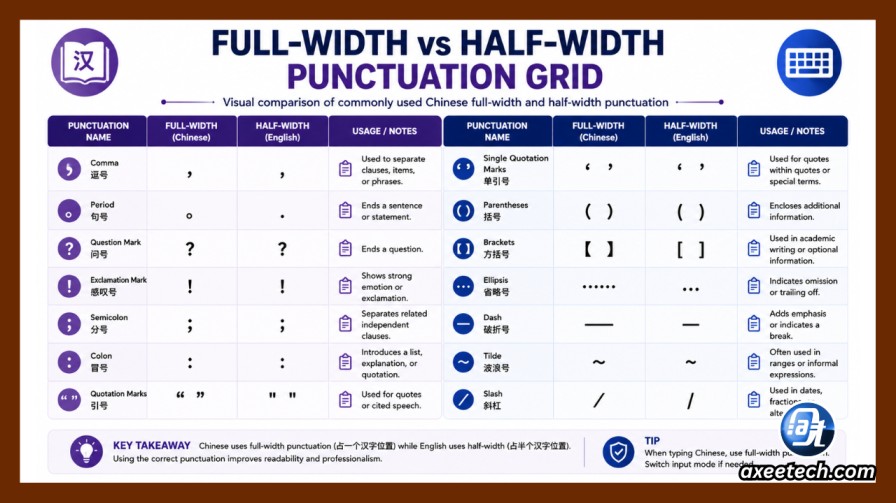
When conducting character counts for formal Chinese essays or translations, full-width punctuation marks are traditionally counted as individual characters because they occupy a complete typographical character block.
Chinese Reading Speed vs. English Reading Speed
- Silent Reading Speed: An educated native Chinese speaker reads an average of 300 to 500 Chinese characters per minute (CPM) for non-technical articles and news.
- Complex Technical / Academic Text: Reading speed drops to 180 to 250 characters per minute.
- Audio / Speech Speed: Standard conversational Mandarin (such as news broadcasting or audiobooks) is spoken at approximately 200 to 260 characters per minute.
Frequently Asked Questions (FAQ)
What is a Chinese Character Counter?
A Chinese Character Counter is an online text analysis tool specifically engineered to parse CJK (Chinese, Japanese, Korean) Unicode blocks. It accurately isolates Chinese Hanzi characters (汉字), full-width punctuation marks, English alphanumeric words, and whitespace to provide detailed text density metrics.
How many characters are in Mandarin Chinese?
The complete inventory of Chinese characters spans over 50,000 to 80,000 characters in comprehensive historical dictionaries (such as the Zhonghua Zihai). However, modern everyday usage requires significantly fewer:
- 2,500 to 3,500 characters cover over 99% of written Chinese media, newspapers, and websites.
- 3,000 characters represent the baseline for advanced literary and professional fluency (HSK Level 7–9).
How does Microsoft Word count Chinese characters?
Microsoft Word provides two distinct metrics in its Word Count dialogue box:
- Characters (no spaces): Counts every individual Hanzi character plus individual English letters and punctuation.
- Asian characters and Korean words: Specifically isolates and counts CJK ideographs separately from space-delimited English words.
Does a Chinese Character Counter count Simplified and Traditional Chinese?
Yes. Both Simplified Chinese (简体中文) used in Mainland China and Singapore, and Traditional Chinese (繁體中文) used in Taiwan, Hong Kong, and Macau, fall within the standardized Unicode CJK Unified Ideographs block (\u4e00-\u9fa5) and are counted identically.
How many Chinese characters make up a standard 500-word essay equivalent?
A standard 500-word English essay translates to approximately 750 to 850 Chinese characters. In Chinese academic institutions, a standard short essay assignment typically specifies a requirement of 800 to 1,000 characters (800–1000字).
How do spaces count in Chinese text?
In authentic Chinese prose, spaces are not used between words. If spaces are present (for example, between Chinese characters and English words), an accurate counter provides both Total Characters with Spaces and Characters without Spaces, allowing you to adhere strictly to formal publication and translation guidelines.
How do social media platforms calculate character limits for Chinese?
Platforms like X (Twitter) operate on a weighted character system where Latin characters (A-Z) count as 1 weight (280 max), while CJK characters count as 2 weights (140 max). In contrast, Chinese platforms like Weibo allow up to 140 to 2,000 raw Chinese characters per post.
What is the difference between Chinese character count and word count?
A character count (字数) counts each individual Hanzi ideograph separately. A word count (词数) counts semantic words, which often consist of 2 or more characters combined together (e.g., "人工智能" is 4 characters, but represents 1 word: “Artificial Intelligence”).
Also check Axeetech’s other tools, including: Run On Sentence Checker | Sentence Counter | Meta Title Length Counter | Paragraph Counter |

Axee Davies is the founder of AxeeTech, publishing gaming guides, codes, and Windows how-tos since March 2013. A tech enthusiast for 13+ years — starting with smartphones and Android rooting — he now runs a site that puts out a new guide every day for Roblox players, traders, and Windows users. More about AxeeTech
More Tools You May Like
 MW4 Pre-Load Size Calculator: SSD Space, Partition & Download Time
 MW4 Sensitivity Converter: Convert BO7, Apex & Valorant Settings + FOV & TTK
 AION 2 Stigma Calculator: Free Shard Costs & Skill Breakpoints (All 8 Classes)
 AION 2 Auction House Tax Calculator: Abyss Points & Kinah Profit
 GTA 6 PS5 Pro vs PS5: Free Frame Rate & TV Matcher for Xbox Series X/S
 GTA 6 PC Bottleneck Calculator: Free CPU, GPU & RAM Upgrade Estimator
 Windows 11 Registry Customizer: Classic Right-Click, Disable Copilot & Recall (.REG)
 Windows Partition Size Calculator: Free Exact GB/TB to MB (No 99.9 GB Bug)